
Hip Reduction
(Redirected from Hip Dislocation Reduction)
Other Names
- Posterior Hip Dislocation Reduction
- Hip Dislocation Reduction
- Anterior Hip Dislocation
- Lateral Hip Dislocation
Background
- This page describes techniques to reduce dislocation of the Hip Joint
- Due to significant gluteal muscle antagonism, it is recommended reduction be performed with procedural sedation
Anatomy
Indications
- Hip Dislocation
- Note the vast majority are posterior
Contraindications
- Absolute
- None
- Relative
- Concomitant hip, pelvis or lower extremity fractures may make closed reduction impossible
Procedure
Equipment
- Examination table or patient bed
- Most techniques require 2 physicians
- Spine board can be helpful
- Procedural Sedation
- Require all the appropriate medications and monitoring
Preparation
Posterior Dislocation
| Reduction Technique | Advantages | Disadvantages |
|---|---|---|
| Modified Allis | -Reduced risk of injury compared with the traditional Allis technique -Greater force generated using the stronger leg muscles |
-Patient positioning can be challenging |
| Piggyback/Rocket Launcher | -Greater force generated using the stronger leg muscles -Enhanced control of patient hip position |
-Patient positioning can be challenging |
| East Baltimore Lift | -Generates the most force using the stronger leg muscles of 2 clinicians | -Requires more people |
| Tulsa/Rochester/Whistler | -Can be performed by a single clinician | -Risk of injury to the clinician’s arm if not careful -May not get sufficient force as some of the other techniques -Contraindicated in patients with contralateral lower extremity fractures or dislocations |
| Captain Morgan | -Backboard stabilizes patient and provides better countertraction than a patient bed | -May be difficult for clinicians with shorter legs to gain sufficient leverage -May not get as sufficient force as some of the other techniques |
| Stimson/Modified Stimson | -More ergonomic -Uses gravity to supplement the force needed |
-Can be difficult to position the patient and needs multiple assistants so the patient does not fall off the bed -Less ideal for procedural sedation -More challenging in patients with larger abdominal girth -Contraindicated in patients with cervical spine injury |
^ Table and images[1]


- Modified Allis (Image #1)
- Traditional: physician standing, grasping the patient’s leg with the patient’s knee and hip flexed at 90°
- Physician then applies axial traction while an assistant holds the patient on the bed
- Concern: technique places both the patient and physician at risk of injury, including back strain and falling
- Modification: physician stands on the side of the bed, elevates the patient’s leg by placing it on their shoulder and slowly standing up
- This utilizes the stronger leg muscles
- If the hip is significantly adducted or rotated, may need to rotate the patient 20°-30° on the bed
- This allows sufficient room to get beneath the patient’s leg.
- Piggyback/Rocket Launcher (Image #2)
- Similar to Allis, allows greater control of the hip position.
- The patient is supine at the end of the bed, hip and knee flexed at 90°
- Physician places the patient’s knee over their shoulder, slowly leans forward and stands up while guiding the thigh into adduction.
- Rocket launcher technique: modification wherein the physician begins by adducting and internally rotating the hip to exaggerate the deformity before standing up
- Study: successful reduction in 5 out of 6 cases in the original description
- East Baltimore Lift (Image #3)
- Patient lies supine on the bed, 2 physicians on each side of the patient
- Hip and knee flexed at approximately 90°, physicians lock arms underneath the patient’s knee, while stabilizing the knee at the ankle joint
- Ned should be sufficiently low such that both clinicians’ backs are straight and their knees are bent at approximately 45°
- Use a third person or sheet should stabilize the patient’s pelvis
- Both physicians then stand up slowly, applying axial traction to the femur while gently internally and externally rotating the hip via the ankle
-
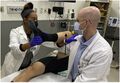 East Baltimore Lift (Image #3)
 -
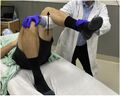 Tulsa/Rochester/Whistler (Image #4)
 -
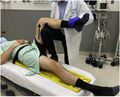 Captain Morgan (Image #5)


- Tulsa/Rochester/Whistler (Image #4)
- Variation of the East Baltimore lift
- Patient flexes both hips and knees on the bed
- Physician places their arm underneath the knee on the affected side, palm on the contralateral knee
- Bed should be sufficiently low such that the physicians back is straight, their knees are bent at approximately 45°
- Physician slowly stands up, using their arm to provide axial traction on the hip, while their other arm gently internally and externally rotates the leg.
- Study: 73.3% success rate (compared with 62.5% for the Allis or modified Allis technique)
- Captain Morgan (Image #5)
- Patient supone on backboard, hip and knee flexed at 90°
- Physician places hand under the patient’s knee, their knee under the proximal aspect of the patient’s lower leg
- Use contralateral hand to stabilize the patient’s knee in flexion
- Physician then plantarflexes at their ankle while using their arm to lift upward, applying axial traction at the patient’s hip
- Pitfall: avoid pushing down on the patient’s ankle, as this may cause ligamentous injury to the patient’s knee
- Study: 92% success rate among 13 cases
- Stimson/Modified Stimson (Image #6, #7)
- Patient is prone, affected leg flexed to 90°, hanging off the end of the bed
- Patient’s hip and knee are flexed to 90°
- Physician applies a downward force to the lower leg with one arm while internally and externally rotating the patient’s hip with their other hand
- Modification: physician places their knee on the proximal calf near the popliteal, and slowly transfers their weight to the bent knee
- Not Reviewed (Need to be added)
- Bigelow Maneuver
- Lefkowitz Maneuver
- Howard Maneuver
- Lateral Traction Method
- Skoff Maneuver
Anterior Dislocation
- Closed Reduction Maneuvers for Anterior Hip Dislocations[2]
- Allis Leg Extension Method
- Reverse Bigelow Method
- Lateral Traction Method
- Stimson Gravity Method
Aftercare
- General
- Strict immobilization is not recommended
- Early active and passive range of motion exercises with either no weight-bearing or toe-touch weight-bearing (5-10 pounds) for the first several weeks[3]
- Restrictions
- Avoid flexing hip beyond 90°
- Avoid any twisting motions
- Avoid crossing their leg past midline
- Abduction Brace
- While commonly used, abduction braces remain controversial
- Have not been demonstrated to reduce the risk of recurrent dislocations in patients with prosthetic hips[4]
Complications
See Also
References
- ↑ Gottlieb, Michael. "Managing Posterior Hip Dislocations." Annals of Emergency Medicine (2022).
- ↑ Dawson-Amoah K, Raszewski J, Duplantier N, Waddell BS. Dislocation of the Hip: A Review of Types, Causes, and Treatment. Ochsner J. 2018;18(3):242–252. doi:10.31486/toj.17.0079
- ↑ Clegg, Travis E., et al. "Hip dislocations—epidemiology, treatment, and outcomes." Injury 41.4 (2010): 329-334.
- ↑ DeWal, Hargovind, et al. "Efficacy of abduction bracing in the management of total hip arthroplasty dislocation." The Journal of arthroplasty 19.6 (2004): 733-738.
Created by:
John Kiel on 26 September 2022 15:56:40
Authors:
Last edited:
26 September 2022 17:30:59
Category: