
Joints Anatomy
(Redirected from Joints Anatomy Main)
Description
-
![Anatomy of the human upper limb: (A) upper limb segments and (B) shoulder, elbow, and wrist skeletal structure.[1]](/w/images/thumb/6/68/Upper_extremity_joints.jpeg/120px-Upper_extremity_joints.jpeg) Anatomy of the human upper limb: (A) upper limb segments and (B) shoulder, elbow, and wrist skeletal structure.[1]
Anatomy of the human upper limb: (A) upper limb segments and (B) shoulder, elbow, and wrist skeletal structure.[1] -
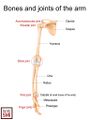 Bones and joints of the upper extremity
 -
![Typical Z (zygapophyseal/ facet) joint. Each facet joint has articular cartilage, the synovium where synovial fluid is produced, and a meniscus.[2]](/w/images/thumb/f/fa/Zygapophyseal_Joint_anatomy.jpg/120px-Zygapophyseal_Joint_anatomy.jpg) Typical Z (zygapophyseal/ facet) joint. Each facet joint has articular cartilage, the synovium where synovial fluid is produced, and a meniscus.[2]
Typical Z (zygapophyseal/ facet) joint. Each facet joint has articular cartilage, the synovium where synovial fluid is produced, and a meniscus.[2] -
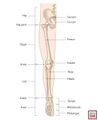 Joints of the lower extremity
![Anatomy of the human upper limb: (A) upper limb segments and (B) shoulder, elbow, and wrist skeletal structure.[1]](/File:Upper_extremity_joints.jpeg)

![Typical Z (zygapophyseal/ facet) joint. Each facet joint has articular cartilage, the synovium where synovial fluid is produced, and a meniscus.[2]](/File:Zygapophyseal_Joint_anatomy.jpg)


General
- This page summarizes all the bony articulations of the human body
- It also summarizes the types of joint by structure and function
Joint Anatomy
By Structure
- Fibrous Joints: Bones are joined by dense connective tissue; no movement
- Examples: skull sutures
- Cartilaginous Joints: Bones are connected by cartilage; limited movement
- Examples: spine, ribs, pubic symphysis
- Synovial Joints: Most common; freely movable joints with a synovial cavity
- Examples: knee, shoulder
By Function/ Degree of Movement
- Synarthrosis: Immovable
- Example: skull
- Amphiarthrosis: Slightly movable
- Example: intervertebral discs
- Diarthrosis: Freely movable
- All synovial joints
Types of Synovial Joints
- Hinge: Allows bending and straightening (e.g., elbow, knee)
- Ball-and-Socket: Multidirectional movement and rotation (e.g., shoulder, hip)
- Pivot: Rotational movement around a single axis (e.g., neck)
- Saddle: Movement in two directions (e.g., thumb)
- Condyloid (Ellipsoidal): Movement but no rotation (e.g., wrist)
- Gliding (Plane): Sliding or gliding movements (e.g., between tarsal bones)
Joints of the Body
- Intercarpal Joints
- Carpometacarpal Joints
- Metacarpophalangeal Joints
- Proximal interphalangeal Joints
- Distal interphalangeal Joints
- Distal Tibiofibular Joint
- Ankle joint
- Subtalar Joint
- Transverse Tarsal Joint
- Tarsometatarsal joints
- Metatarsophalangeal Joints
- Proximal and Distal Interphalangeal Joints
See Also
References
- ↑ Gull, Muhammad Ahsan, Shaoping Bai, and Thomas Bak. "A review on design of upper limb exoskeletons." Robotics 9.1 (2020): 16.
- ↑ Steilen, Danielle, et al. "Chronic neck pain: making the connection between capsular ligament laxity and cervical instability." The open orthopaedics journal 8 (2014): 326.
- ↑ Image courtesy of geeksforgeeks.org