
Subacromial Bursa
(Redirected from Subacromial bursa)
Description
-
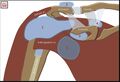 Bursa aorund the shoulder joint: 1. subacromial-subdeltoid bursa 2. Subscapularis bursa 3. Sucoracoid bursa 4. Coracoclavicular bursa 5. Supra-acromial bursa.
 -
![Illustration of the subacromial bursa[1]](/w/images/thumb/8/8c/Illustration_of_the_subacromial_subdeltoid_bursa.jpg/120px-Illustration_of_the_subacromial_subdeltoid_bursa.jpg) Illustration of the subacromial bursa[1]
Illustration of the subacromial bursa[1]

![Illustration of the subacromial bursa[1]](/File:Illustration_of_the_subacromial_subdeltoid_bursa.jpg)


Name
- Subacromial Bursa
- Subacromial-subdeltoid bursa (SASD)
- Bursa Subacromialis
- Subdeltoid Bursa
General
- Bursa within the shoulder which protects the space between the acromion and rotator cuff
- In most health shoulders, it is simply a potential space
- Largest of the bursa within the glenohumeral joint
- One of the Bursa of the Shoulder
Gross Anatomy
- Found deep to the deltoid muscle and coracoacromial ligament
- Superior to the glenohumeral joint capsule, supraspinatus tendon
- It does not typically communicate with the glenohumeral joint
- Communication can occur in the presence of rotator cuff pathology
- Laterally, it lies deep to the deltoid muscle, and this portion is often called subdeltoid bursa
- Terminates an average of 4 cm from the mid-point of the acromion
- Osseous landmark corresponds to posterior bursal reflection
- Medially, it is found in close relation to the acromioclavicular joint
- Envelopes the bicipital groove as it extends inferiorly
- Superficial relationships include the rotator interval, supraspinatus tendon
- Invested by parallel layers of the peri-bursal fat
- May or may not interface with infraspinatus
Function
- Prevents friction
- Protects the joint capsule
- Prevents wear and tear of the supraspinatus tendon
Ultrasound Findings
- Anechoic fluid can be seen within the subacromial bursa when inflamed
- Physiological distention is typically less than 1 mm
- The hyperechoic per-bursal fat forms a prominent interface
- Between the deltoid/acromion and the underlying supraspinatus
- Allows for identification of the potential space
- Dynamic visualization
- Abduction and adduction of the shoulder should demonstrate smooth translocation of the bursal reflection
Clinical Significance
See Also
References
- ↑ Image courtesy of anatomyzone.com
- ↑ de Witte, Pieter Bas, et al. "Study protocol subacromial impingement syndrome: the identification of pathophysiologic mechanisms (SISTIM)." BMC musculoskeletal disorders 12 (2011): 1-12.
- ↑ Case courtesy of Chris O'Donnell, Radiopaedia.org, rID: 38306
- ↑ Case courtesy of Bruno Di Muzio, Radiopaedia.org, rID: 22396