
Longissimus
Description
-
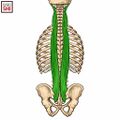 Longissimus muscle
 -
![The erector spinae muscles[1]](/w/images/thumb/7/72/Erector_spinae_muscle_gruop.jpg/115px-Erector_spinae_muscle_gruop.jpg)
-
![Deep spinal muscles including semispinalis, multifidus, spinalis, longissimus, iliocostalis[2]](/w/images/thumb/4/46/Deep_spinal_muscles.jpg/77px-Deep_spinal_muscles.jpg) Deep spinal muscles including semispinalis, multifidus, spinalis, longissimus, iliocostalis[2]
Deep spinal muscles including semispinalis, multifidus, spinalis, longissimus, iliocostalis[2] -
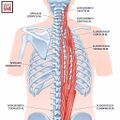 Anatomy of some of the back muscles

![The erector spinae muscles[1]](/File:Erector_spinae_muscle_gruop.jpg)
![Deep spinal muscles including semispinalis, multifidus, spinalis, longissimus, iliocostalis[2]](/File:Deep_spinal_muscles.jpg)


Name
- Longissimus
General
- Intermediate portion of Erector Spinae
- Extends from lumbar spine to posterior head
Subsegments
- Longissimus Lumborum
- Longissimus Thoracis
- Longissimus Cervicis (Transversalis Cervicis)
- Longissimus Capitis (Trachelomastoid)
Origin
- Transverse processes of lumbar and thoracic vertebrae
- Accessory processes of lumbar vertebrae
- Anterior lumbodorsal fascia
- Articular processes of C4-C7
Insertion
- Transverse processes of thoracic vertebrae
- Ribs 3-12 (between tubercles and angles)
- Transverse processes (posterior tubercles) of vertebrae C2-C6
- Mastoid process (posterior margin)
Actions
- Bilateral: Extension of trunk, cervical spine, and head
- Unilateral: Sidebending of trunk, cervical spine, and head to same side
- Depression of ribs (accessory muscle of expiration)
Vascular Supply
- Deep Cervical Artery
- Posterior Intercostal Arteries
- Subcostal Arteries
- Lumbar Arteries
- Lateral Sacral Artery
Innervation
- Spinal nerves C1-S1 (Dorsal Rami)
Clinical Significance
See Also
References
- ↑ The Muscles and Swimming, Santiago Bustos
- ↑ Galbusera, F., and H. J. Wilke. "Biomechanics of the Spine: Basic Concepts." Spinal Disorders and Treatments. 1st ed: Academic Press, 2018. 456 p (2018).
- ↑ Mello, Sergio Silva, et al. "Posterior lumbar plexus block in children: a new anatomical landmark." Regional Anesthesia & Pain Medicine 32.6 (2007): 522-527.